Looking for authentic Pata Negra? A ham or shoulder is advertised under that name, but the small print says “50% Iberian”. Before placing an order, take a closer look. The product may be delicious and carefully made, yet that does not mean it belongs to the category suggested by the headline. Clear information matters because it tells you what you are actually paying for.
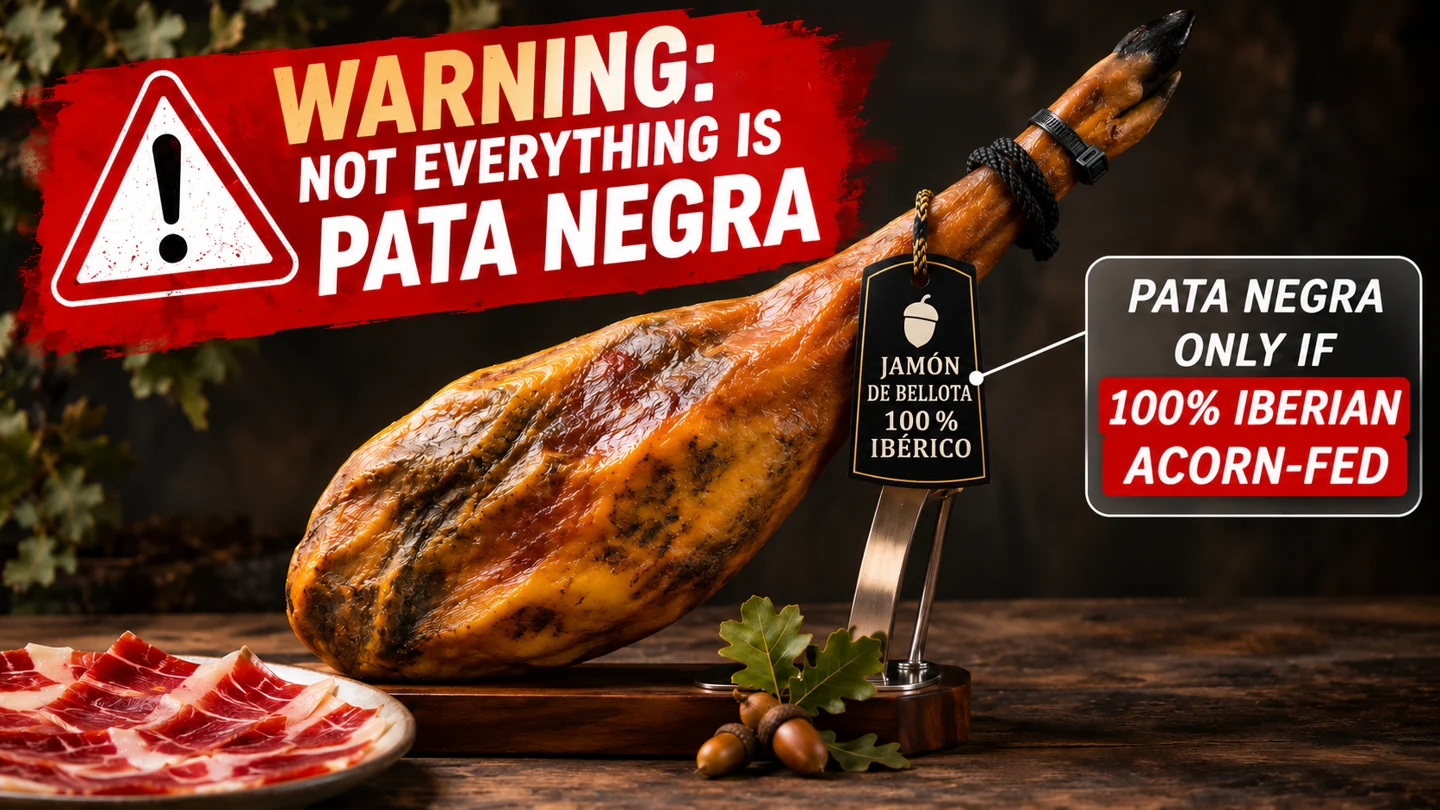
Authentic Pata Negra combines a specific feeding and rearing category with 100% Iberian breed status. A dark hoof, an impressive maturation time or an elegant hanging tag cannot establish those facts on its own. This guide explains how to read a Spanish ham listing, interpret the seal colours and compare products fairly without dismissing the merits of other categories.
What does authentic Pata Negra actually mean?
Article 4.5 of Spain’s Royal Decree 4/2014 reserves the optional term “Pata negra” for the designation “de bellota 100% ibérico”, provided the product meets the standard’s requirements. The expression has a precise meaning. It is neither a blanket name for Iberian ham nor simply a way of saying that a product is high quality.
The distinction also applies to shoulder ham, known as paleta. Jamón comes from a hind leg and paleta from a front leg. A shoulder can qualify as Pata Negra when it belongs to the correct category. Conversely, a large or expensive hind-leg ham does not automatically qualify simply because of its size or price.
Acorn-fed and 100% Iberian answer different questions
The Iberian percentage concerns the animal’s breed. It does not, by itself, explain how the pig was fed. De bellota is a regulated feeding and management category, with conditions that go beyond a pig having eaten some acorns. To understand the product, look for both pieces of information and check that the description agrees with its full sales designation.
For example, de bellota ham from a 75% Iberian pig and cebo de campo ham from a 100% Iberian pig are different products. The first lacks the breed percentage required for Pata Negra; the second is not in the bellota category. Either might suit your tastes, but neither meets both conditions at the same time.
The four official Iberian ham seal colours
The seal is the identification band attached to the whole leg. It is different from a producer’s cardboard tag or decorative ribbon. ASICI explains the four categories and notes that Protected Designations of Origin can use their own seals while respecting the same colour system.
| Seal | Spanish category | Iberian breed percentage |
|---|---|---|
| Black | De bellota 100% ibérico: eligible for Pata Negra | 100% |
| Red | De bellota ibérico | 50% or 75% |
| Green | De cebo de campo | 50%, 75% or 100% |
| White | De cebo | 50%, 75% or 100% |
In the bellota category, the final fattening stage relies on acorns and other natural resources of the dehesa, subject to the category’s requirements. Cebo de campo combines compound feed with field resources under outdoor management conditions. Cebo uses compound feed in an intensive rearing system. The distinction therefore goes beyond whether an animal has eaten acorns: how it is managed and how the category is verified also matter.
The table applies to both jamón and paleta. For green and white seals, read the breed percentage on the label: the colour alone does not specify it. Black packaging, a black ribbon or a commercial name meaning “Black Label” is not the same thing as the standard’s black identification seal.
Why 50% Iberian cebo shoulder is not Pata Negra
Consider an anonymous example: a headline promises “Pata Negra shoulder”, while the specifications state de cebo and 50% Iberian breed. Those details do not match the designation reserved for Pata Negra under the Spanish standard. A respected brand, lengthy maturation or attractive photography does not change the category.
An inconsistent description is not enough to establish that a particular business has committed fraud. It is, however, a good reason to request the complete sales designation before ordering. If you want cebo shoulder, compare it with shoulders of the same category and breed percentage. If you want Pata Negra, look for information confirming bellota 100% ibérico.
Marketing language worth checking carefully
Words such as “premium”, “selection” and “grand reserve” may contribute to a product’s presentation, but they do not prove Pata Negra status. A story about generations of craftsmanship does not replace missing specifications either. Ask a practical question: does this listing clearly identify the cut, feeding category and breed percentage of the reference I have selected?
Pictures of acorns, oak trees or pigs outdoors can suggest particular characteristics. Check whether the product’s designation supports that impression instead of inferring its category from the scenery. Spanish rules also restrict references evoking bellota, dehesa and montanera. An appealing illustration is not a substitute for checking the actual product identification.
Long maturation and outdoor rearing are not enough
Maturation matters to the finished ham, but it does not alter the pig’s breed or feeding category. Keeping a cebo ham in a cellar for longer does not turn it into bellota. Similarly, outdoor access alone does not establish Pata Negra status: cebo de campo is a separate category and Iberian breed percentages can differ.
When comparing offers, establish the category first. Then consider the producer, ingredients, format, weight and stated maturation. A lower price per kilogram may reflect a different product rather than an exceptional discount on an equivalent one. Keeping those factors separate lets you judge value without assuming that the most expensive ham is always the right choice for your household.
How to check authentic Pata Negra before buying online
Find the full product designation and breed percentage. Check whether the photograph shows the selected reference or is merely illustrative. For a whole leg, ask for a readable photograph of the label and seal if the listing leaves questions unanswered. A hanging tag can be informative, but its appearance alone does not establish the regulated category.
With boneless or sliced ham, the original leg’s identification band will not necessarily be present inside the pack. What matters is the labelling and traceability appropriate to the format you are buying. Check net weight, the number of packets and storage instructions as well. Identifying the category is essential, but it does not answer every practical question about what will arrive.
You can ask the seller: “What are the full sales designation, Iberian breed percentage and feeding category of this reference? Can you provide its labelling?”. A precise answer is more useful than another quality adjective. Keep a copy of the listing and your order confirmation so that you know exactly which characteristics were offered.
Spanishtaste’s commitment to transparency
At Spanishtaste, only de bellota 100% Iberian hams and shoulders carry our visual “Pata Negra” badge on their product photographs. We add it deliberately to make those products easier to recognise, even before you open the description. It is a commercial signpost provided by Spanishtaste, not a replacement for the product’s seal or certification.
We sell different categories of Iberian ham to suit different tastes and budgets. A product without this badge can still offer excellent value. It does not need the Pata Negra name to deserve a place on your table: it needs an accurate description. We do not infer a product’s regulated category solely from a brand name or the colour of its commercial label.
Spanishtaste has sold ham online since 2006. Our aim is to help you understand your choice, whether you prefer a whole leg, a shoulder or convenient sliced packs. Compare the feeding category, breed percentage and format across our whole hams and shoulders. Choosing a category other than bellota 100% Iberian is entirely reasonable when it matches your preferences and the information is clear.
For a practical comparison, look at 5J bellota 100% Iberian ham, Juan Pedro Domecq bellota 100% Iberian shoulder and COVAP cebo de campo 100% Iberian ham. Sharing the same breed percentage does not make their feeding categories identical.
International advertising needs a case-specific assessment
The definition in this guide comes from the Spanish quality standard. Assessing the legality of a particular international advertisement requires consideration of the market, the product and the applicable rules. This article does not establish any infringement or assume that other countries have weaker controls. For shoppers, the practical approach is to expect equal clarity in every language and check that translations retain the essential product details.
Quick questions about authentic Pata Negra
Is all bellota ham Pata Negra? No: bellota also includes 50% and 75% Iberian products. Is all 100% Iberian ham Pata Negra? No: you must also check the feeding and rearing category. Does a black hoof prove it? No: appearance cannot replace the appropriate designation and identification.
Quality begins with transparency. At Spanishtaste, Pata Negra means exactly what it should mean. Take a moment to check those two complementary facts before buying. Understanding them makes it easier to compare offers and enjoy the ham you choose for what it really is.
Official sources
Consult Royal Decree 4/2014 in Spain’s official gazette, particularly Articles 3, 4 and 9, and ASICI’s guide to seals and categories. These sources allow you to check the definition and colour system directly.